Thursday, March 30, 2006

Springtime Pruning cont. "What lies beneath?"

On Thursday, March 30, the temperatures were climbing well into the 50's again. I started worrying about the vinifera under the tarps. I planned to leave them under until Easter or even the beginning of May. But I began to worry that the heat may cook them. To hedge my bets, I decided to remove the tarps from half of them. I removed the tarp from the North half.

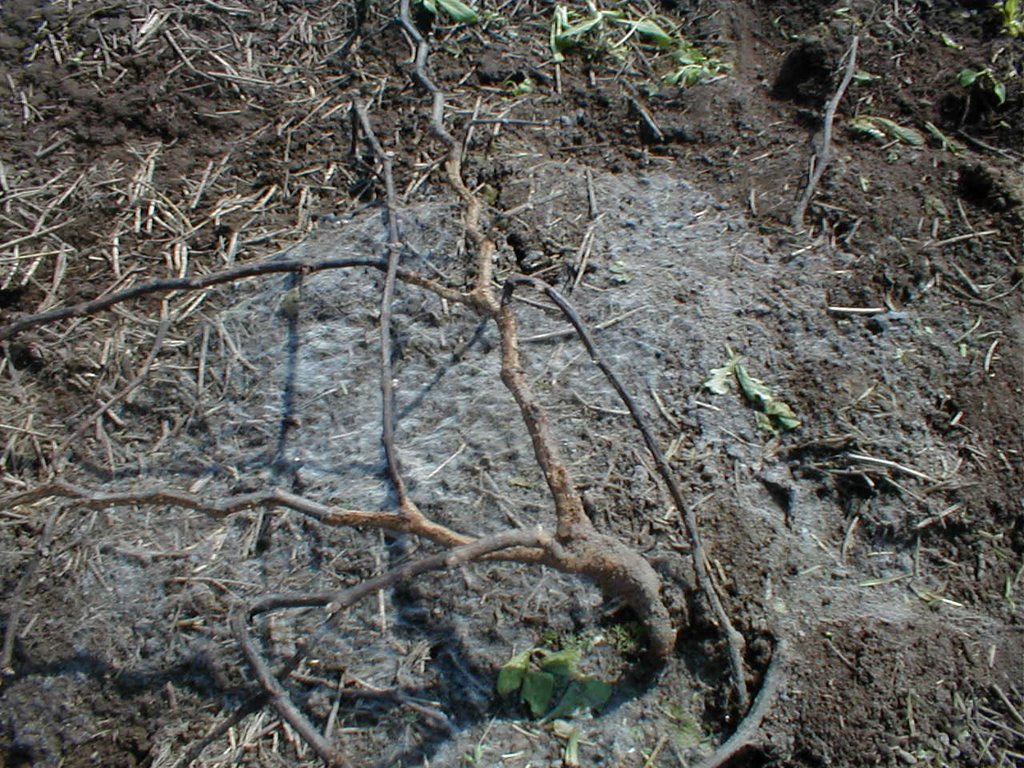
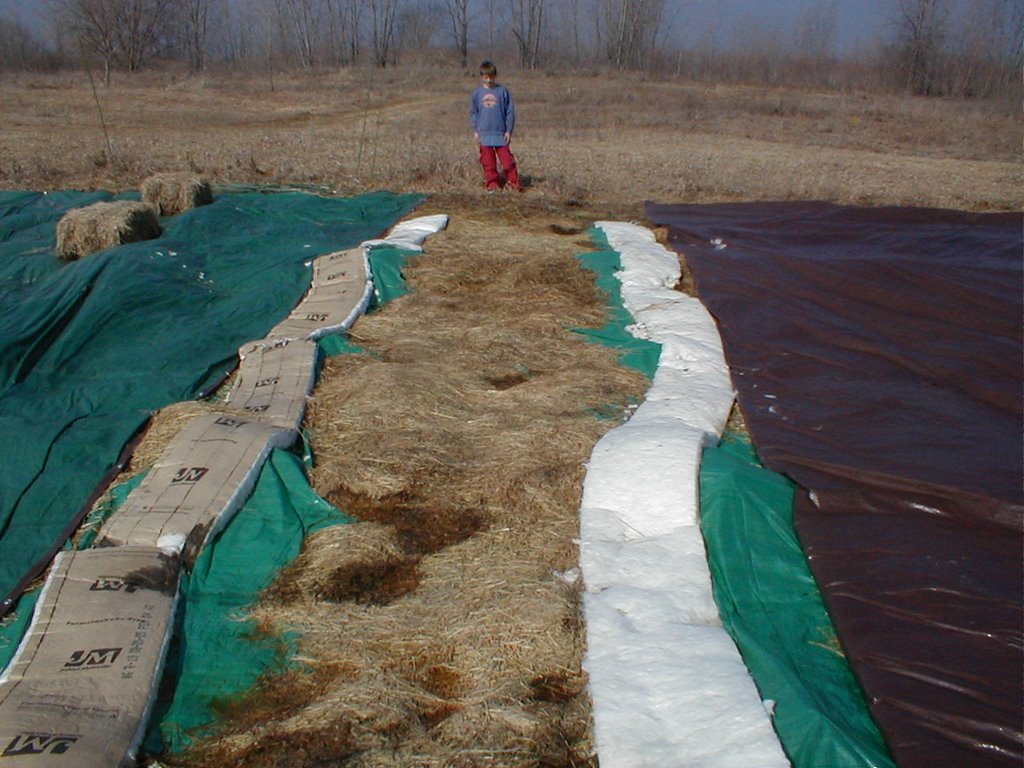
I have two layers of tarp, with hay and fiberglass insulation sandwiched between them. It was my hope that these would be a nice dry layer to keep the vines warm. Unfortunately, I saw more rodent holes in the top tarp. It slowly became apparent that my tarp/hay/insulation sandwich was an ideal rodent overwintering home. The holes in the top tarp also let rain and melted snow in between the tarps. This caused about 2/3 of the hay and insulation to become wet. Not nearly as good of an insulator.

After scraping off the wet hay and insulation, we removed the lower tarp layer. Things did not look too bad. The rodents did chew on the vines, but not to the extent that I feared. In fact most of the chewing looked to be very superficial near the base ... almost like they only ate the wax covering the graft unions.

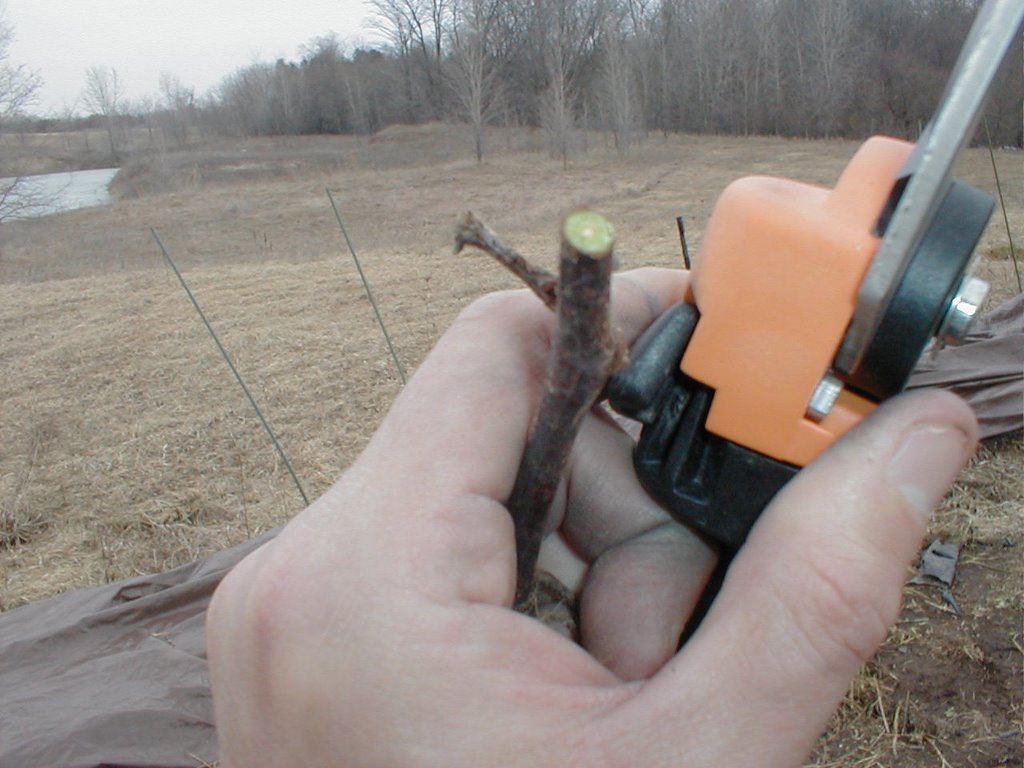
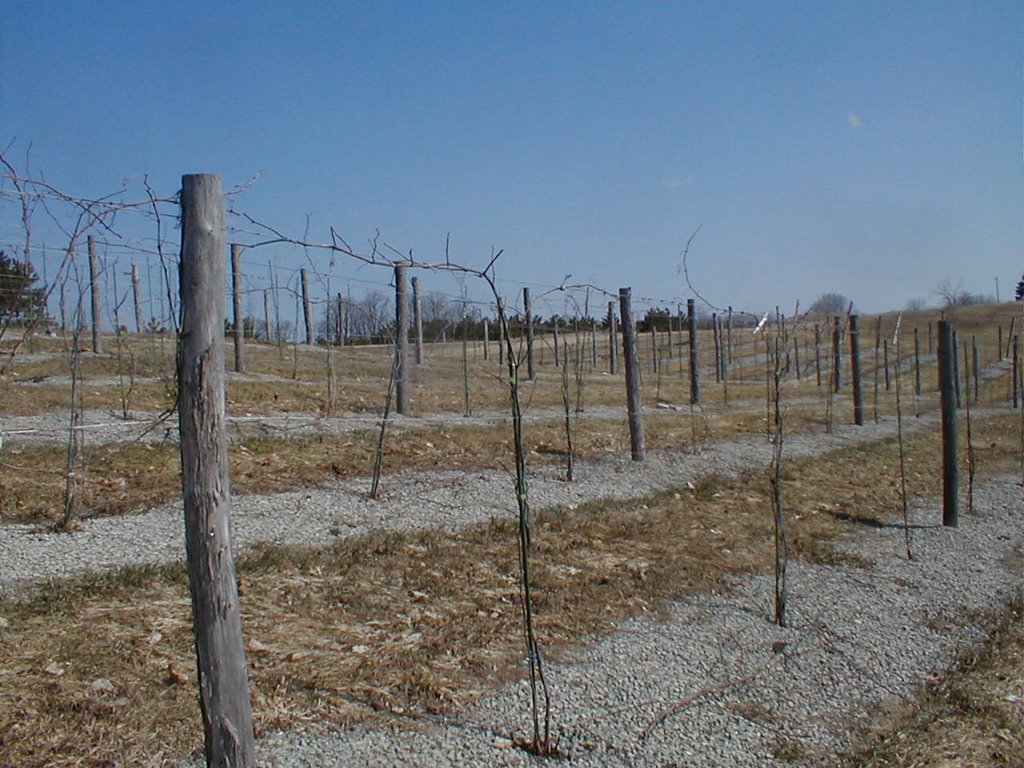
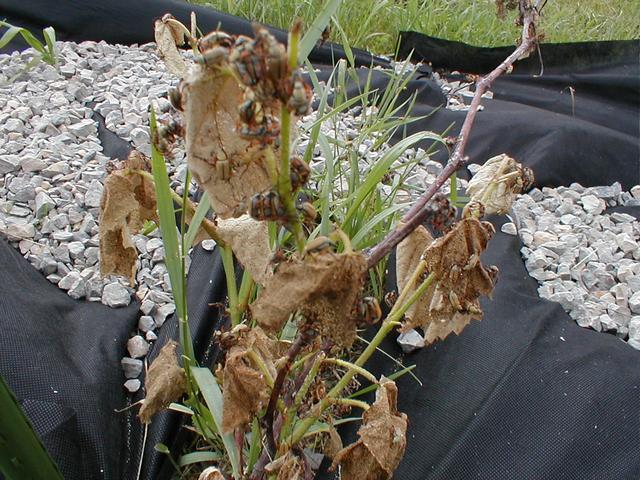
I will know in about a month if this gnawing actually harmed the vines. My pruning showed little winter kill on the vines, but much more than I had expected. Probably due to the lack of insulation. The merlot and Cab Franc faired the best. The chardonnay did next best, with the Cab Sauvignon doing the worst. The cab Sauvignon however were planted 2-3 weeks later, and did not look as good as the other going into the winter, so that may have had more to do with their health than anything. I still plan on putting the high tunnel up in the next couple of months.(merlot pruning, looking pretty green!)

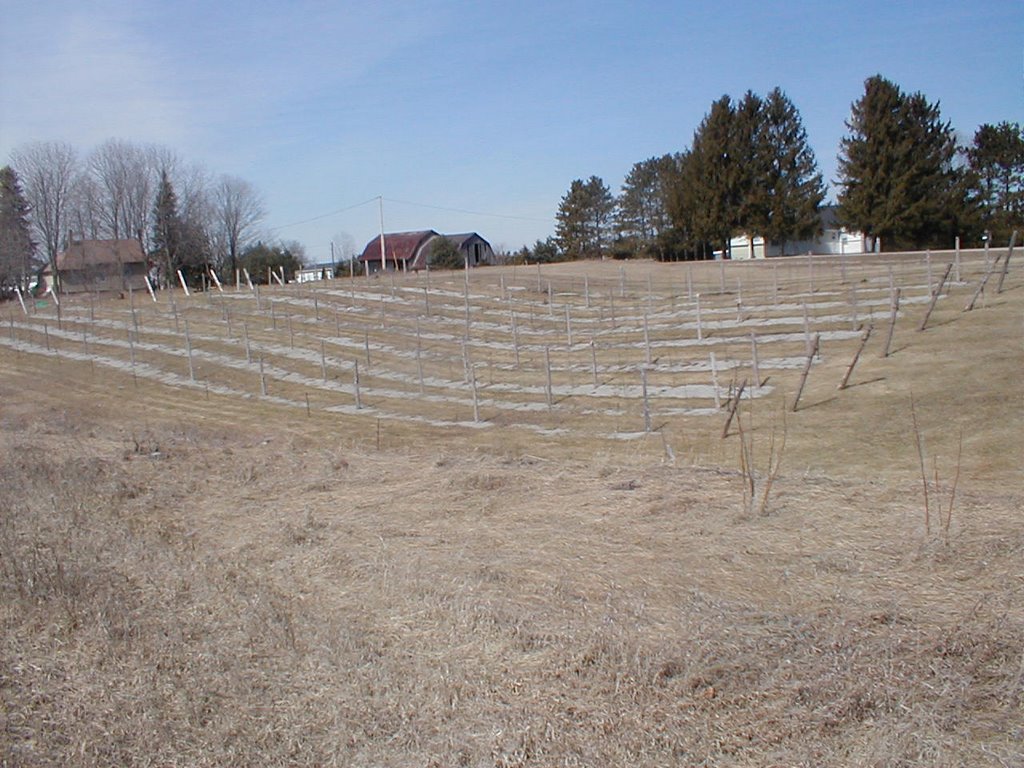
I put up some light wire around the part of the vineyard that I removed the tarps. Hopefully enough of a deterrent to keep the deer from chewing on the leafless vines until I get up to install the high tunnel.

Wednesday, March 29, 2006

Springtime Pruning

It's beginning to feel like spring may have finally arrived. I took off all of last week to do vineyard work. Number one on my agenda was pruning.

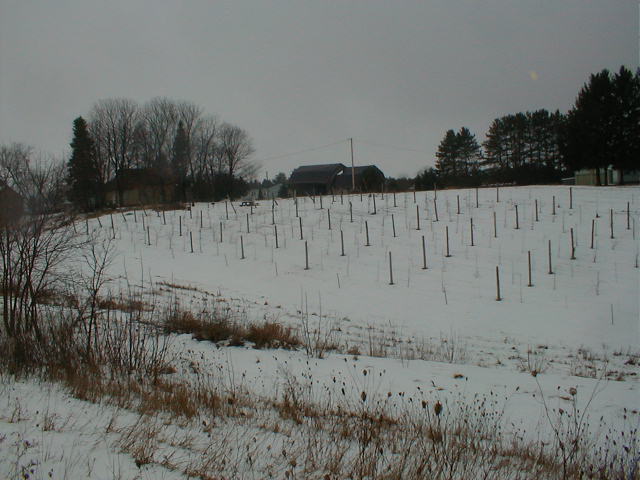
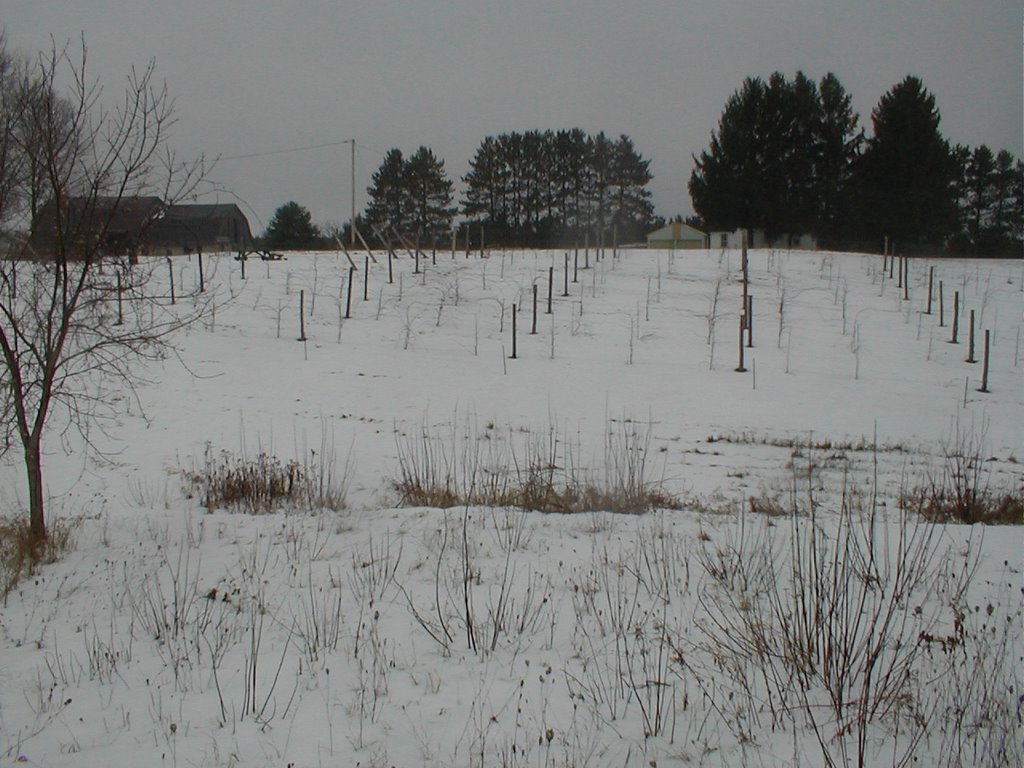
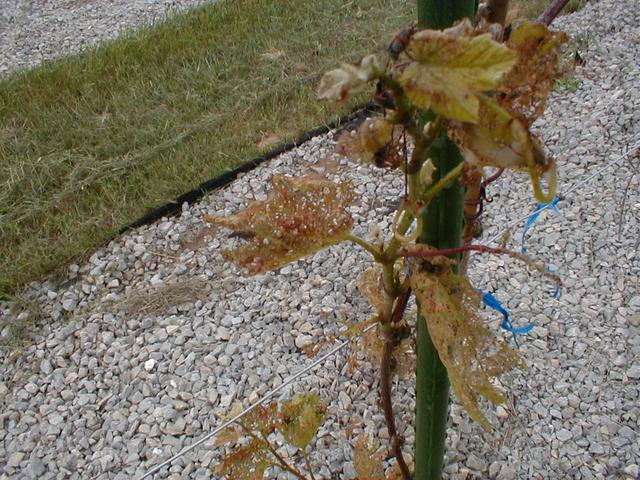
It took me about 2 days (March 27-28) to prune the park vineyard. Overall things looked better than I expected. I saw little winter kill on the Foch, LaCrosse and St Pepin. Some of the ends that did not harden off were brown, but for the most part things looked good. I've been fooled before, thinking that things were alive when pruning, and then finding that they didn't make it. But I'm more optimistic this year. I did see more winter damage in the Landot noir, but that is the least hardy of my vines and is somewhat expected.

Here is a pruned foch vine: ... still kind of a baby, but should have a small crop this year!


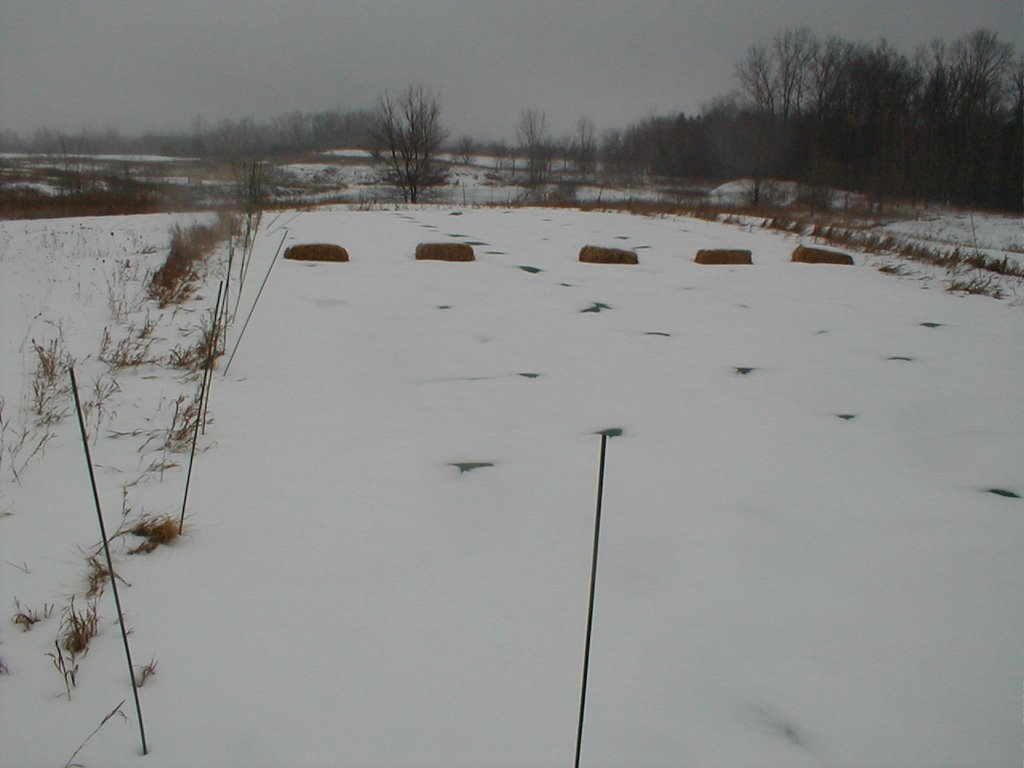
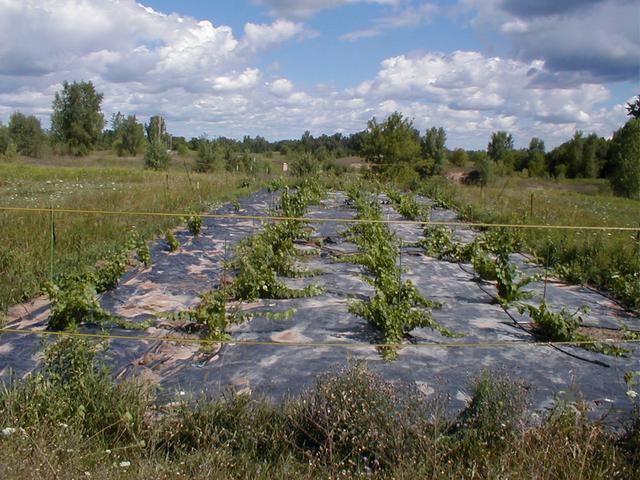
I was also finally able to check out the experimental vinifera vineyard. The tarps on one end were pulled up slightly, but overall things looked pretty good at this point.
I did see a couple of holes chewed into the tarp which concerned me. I hoped at this point not to find too many rodents living under the tarps.


On Wednesday, March 29. I, my brother Jon, and my nephew cleared the "scrub" boxelders on the hillside overlooking my vineyard. Getting rid of these not only improve the looks around the vineyard, but also allows better air flow around the vineyard, and hopefully will make the deer feel less secure chewing on the vines.

Tuesday, February 21, 2006

High tunnel heat math ... is it worth it?

The cold over the last weekend got me calculating how much heat I would need for my vinifera to survive a cold snap. Although I'm sure the equation has several more terms than I care to account for, I think I can use a basic equation for a rough estimate.

(Surface AREA in SQFT )*(Temperature difference in F)*1.2 =BTUs of heat needed

The hoop house I intend to use will have an area of about (96*16*PI)+(PI*16*16)=6,534.5 SQFT

Let's try an example:
From the last weekend ... I spent 19 consecutive hours below 3 F The average Temperature over this period was about -8 F or an average temperature difference during this time of about 11 F.

So ..... (6,534.5*11*1.2)=86,255 BTU/hour needed to remain at 3F or higher.
I have two 60,000 BTU forced air kerosene heaters. They should be able to supply a total of 120,000 BTUs per hour. They can last about 12 hours of continuous heating.

So based on this ... I should be able to last a little less than 17 hours. These calculations do not take in account any thermal inertial due to heat retained in the ground or any additional insulation ... which I intend to use. I may have to get a couple of backup heaters ... or refuel more often.

Next, I have to build my computerized controllers .... luckily I have quite a bit of experience with this part. The entire computer controlled heating system should cost about $400 to build(including heaters). Fuel should cost about $4/hr. Even in a cold year, cheap insurance to keep the vines alive. This year it would have cost me about $100 bucks in fuel costs (worse case) to allow my 75 vinifera vines to survive the winter.


Extending the costs over 10 years .... assume on average 100 hours of heat per year over 10 years:
high tunnel=$4000 --- one time cost
heat=$4000 ---- ~$400 per year
Other misc =$500 --- sensors, computer controller ... tarps etc.
______
$8500
Assume 20 lbs/vine/year
=20*75*10=15,000

So this system will add $0.56 per pound of grapes. Even if you go best/worst case ... I think you can go plus or minus a .25 per pound i.e. $.31 - $.81/lb . .... note vinifera shipped in from the west coast will cost any where from $0.65 to as much as $1.50 per pound (in small quantities) when shipping is included, so then this begins to look competitive. And hey.... they were grown in Wisconsin! And this does not take into account the reduced risks due to Frosts, Winter kill, reduced pests, and the costs associated with them. This is all theory so far ... we will see how reality plays out ... it may be far more harsh than I anticipate, but many of the numbers and costs I used I hope to beat.

Sunday, February 19, 2006

A bit chilly (-17 F in the shade)


A late winter cold snap hit the vineyard this weekend. Friday night the temperature dropped to -17 F. It's the coldest weather we have had since the vineyard was planted in 2003. Last night we dropped down to -7 F. Luckily we had about 10 inches of fresh snow added to the 8 inches already on the ground. I am concerned that the recent mild weather (i.e. all of January, and the beginning of February) may have hurt the hardiness of some of the vines. I think the Vinifera under the tarps were fine. Thankfully the vineyard didn't get as cold as my backyard here in Madison, where I recorded -21F.

Monday, February 13, 2006

What's Under there??

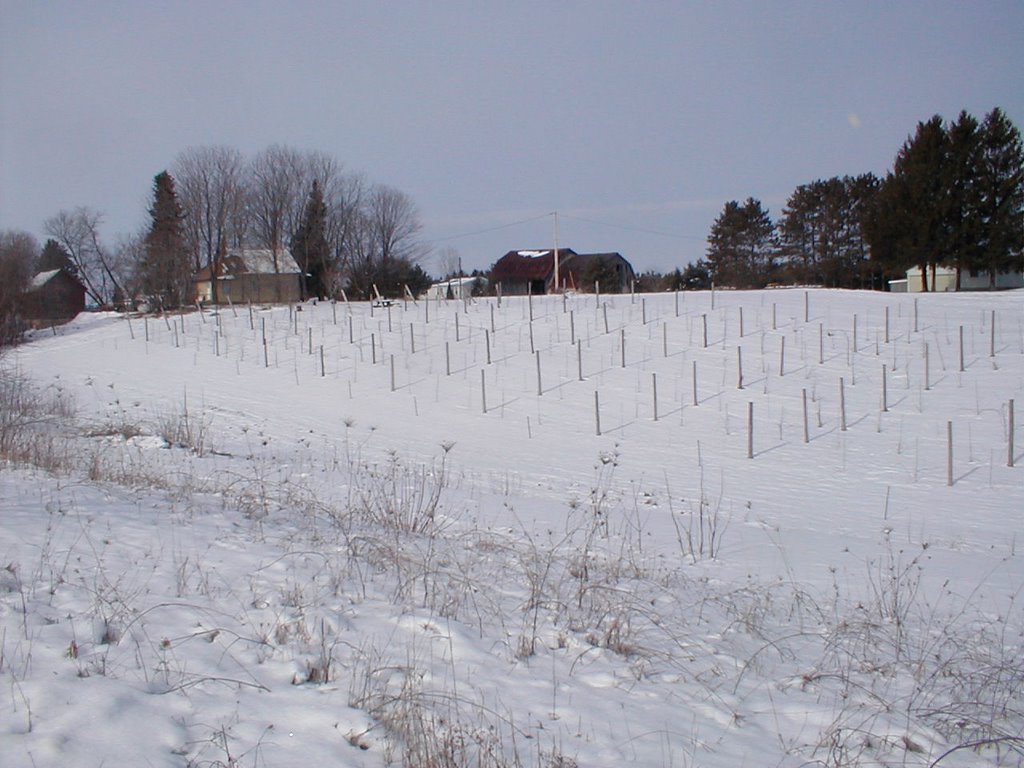
I was up at the vineyard this past weekend. A good 8 inches of snow should keep the ground well insulated for the upcoming cold.

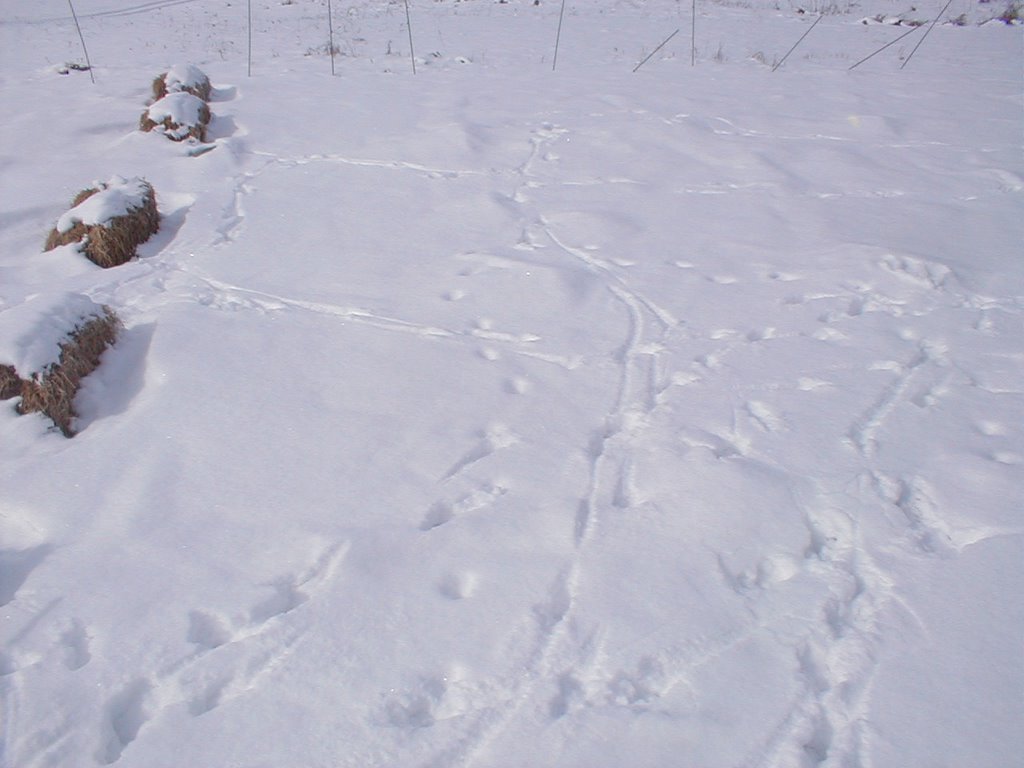
I noticed a lot of activity around the vinifera under the tarp. I saw a lot of tracks ... I think they were either coyote or fox ....


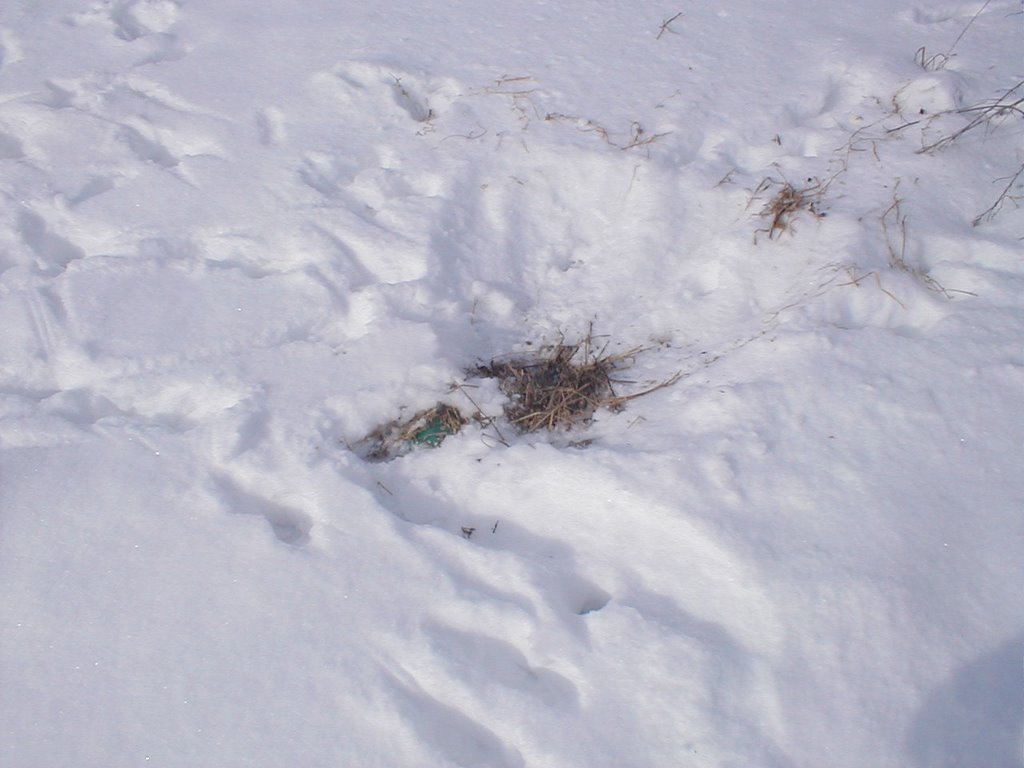
I also see some digging.... I wonder if the coyote (or fox) could here rodents under the tarp?


If so I hope the little critters living under there aren't feasting on the vines!

Sunday, February 05, 2006

Day 2 at the Wine and Grape Conference

Yesterday, was another great day at the conference! The organizers did a spectacular job running this conference.

The day started with a real nice breakfast .... fruit, eggs, sausage bacon, crepes ... you name it, much better than the typical continental breakfast spreads. But enough about that ..... Lets get to the wine and grape talks.

The morning started out with a keynote about the Winegrape industry in Iowa. This was followed by parallel sessions dealing with wine or grapes.

Luckily, two folks I knew and were attending the conference, Randy Harrison and Norm Stilson, attended some of the talks that I missed, so I will have to tap them for more info on the talks I did not attend. (Randy is a amateur winemaker and attended some of the winemaking talks. Norm is a grower and also makes wine, so he was splitting his time between the parallel tracks, as was I.)

So here is the quick summary:

Iowa experience (Mike White)
13 Iowa wineries in 1999 ->52+ wineries by Feb 2006
31 acres grapes growing in Iowa in 1999 -> 600+ in 2005
imported a lot of expertise

Evaluating Cold Climate Cultivars (Dr. Paul Domoto)
Late Frosts have huge impacts on many of the cultivars. And organic is a challenge in the Midwest. Site selection has huge impacts.

Wine Faults (Todd Steiner)
Don't skimp on those sulfites!

Lunch (quite the spread again!)

Wine Makers Forum(various)
Sweeter wine sells ... Iowa and Minnesota wines aren't cheap!

Working together as a State Grape and Wine industry (Donniella Winchell)
With good outreach, networking and smart promotion a grape and wine industry can reap huge benifits.

Dinner and a tribute to Bob Wollersheim
A great dinner and a heart tugging tribute to Bob Wollersheim


If I haven't lost you yet ... here are the details. (note this may or may not be the highlights, just my impressions.)

Iowa experience
This was presented by Mike White (a very entertaining guy by the way) from Iowa State University Extension.
What they have done in Iowa
since 1999 is impressive. Going from ~30 acres of vines to over 600 now. They had 13 wineries in 1999 and 52+ now. This was no accident. It helped that Iowa invested in the industry .... a wine and grape development council was appointed, the Universities hired researchers, extension specialists, and more.

They were also beneficiaries of some unique native winery laws like Native Wineries being exempt from some wine taxes, liberal licensing to sell Native winery wines at businesses that are not typical wine outlets (like flower shops, gift shops, etc) cheap/liberal licensing to allow wine sales by the glass at festivals and events.

This talk made me wonder why ..... WHY ... isn't Wisconsin doing some of the same things?

Evaluating Cold Climate Cultivars
This was presented by Dr. Paul Domoto. Dr. Domoto is a horticulture professor at the Iowa state University. This talk was somewhat Iowa centric, but in some ways was more relevant to my climate than many of the Minnesota oriented talks.
Dr. Domoto talked about two sites growing the same grapes. One site was significantly more frost prone than the other. Three management systems were also evaluated. They were:
-Conventional
-IPM/Best Practices
-Organic Approved

In many cases the difference in these approaches were by far insignificant when it came to site factors ... such as frosts and cold injury. However, in general the organic suffered as one may expect.
Some general Notes:
All of the cultivars varied significantly. While there was a variation between cultivars, there was a huge variation between the sites. When there were late spring frosts, it had a huge impact. The cultivars with late bud beak had virtually no damage.
Winter low temperatures between the two sites varied by about 8 degrees -11F at one site -19F at the other. Huge difference were seen due to bud damage from the colder temperatures.
Additional sites and cultivars have been planted and additional information will be coming from those.
A lot of info was presented in this talk ... I don't think I even hit all of the highlights.


Wine Faults
This was a talk I really looked forward to. It was presented by Todd Steiner from the University of Ohio. We did not get a handout on this, so I have limited notes.
We evaluated 10 wines, 5 red, and 5 white. One red was a control with no faults and one white was a control with no faults. We first tried the whites:
I was easily able to identify the flaw in both #2 and #3 (since I have had wines that suffered each)
1. White Wine control
2. Oxidized white. Brownish in color sweet nutty sherry aroma and taste .... due to too much oxygen . Too much head space, too much splashing when racking. This is the least offensive to me, since I like sherry. But this is a recognized fault.
3. VA problem i.e. volatile acidity problem i.e. acetic acid i.e. VINEGAR. Distinct vinegar smell. Due to poor sanitation, or insufficient sulfites, too much oxygen or head space.
4. lactic acid spoilage. This one smelled like sauerkraut. May sometimes have a ropey filaments in it, but is less common. Due to insufficient SO2(sulfites). Typically due to a natural malolactic culture.
5. Protein haze. We only got to see this one.

Now the reds.
I recognized 2 out of the 4 flaws. Only once did I have a wine suffer from one (#9).

6. Red control
7. High alcohol and fusel alcohols. I thought this smelled a bit like lighter fluid, rubber (and slightly like rotting flesh!) it had a hot taste. This is often due to certain yeast strains and or high fermentation temperatures.
8. Brett ... I have read about this, but did not know what it smelled like. It smells like a first aid kit or band aids. Brett is caused by a bacteria, so sulfites would help, but it is anaerobic so air is less of a factor.
Sometimes found in Bordeaux wines (intentionally?)
9. Film yeast . Wine flowers, ethel acetate. Smelled like fruity nail polish remover. Prevented with adequate sulfites and topping up.
10. Geranium smell due to adding sorbate to a malolactic fermented wine. I have noted this in a couple of wines I've tried ... never my own, since I haven't added sorbate to very many. This example was a commercial wine, and it had an overpowering geranium smell! Simple solution; keep sulfites up so malolactic does not start, or don't add sorbate to a malolactic fermented wine .... be careful with blending .... a malo fermented wine blended with a sorbated wine is just as bad.

Winemaker Round table
I won't go into too much detail here, but this was a fascinating one. We try 10+ different wines with the winemakers of those wines explaining in detail the chemistry and methods for making the wines. Great insights are gained from this. I was shocked at some of the prices that they sell these wines for. I think $12 was the cheapest. Most were between $15 and $20. When we were trying the sweeter wines, one of the wine makers noted that it wasn't his favorite, but by far the sweeter wines were the ones that sell.

Working together as a State Grape and Wine industry
This was the final talk and the keynote. Donniella Winchell gave this presentation .... she is the Executive Director of the Ohio Wine producers association. There was too much information to even touch a little on what was presented in this talk. The bottom line was you really have to get involved and network at every level .... from legislatures to tourism boards to news media. You really need to promote. Great info.

Dinner and tribute to Bob Wollersheim
The conference concluded with a dinner and tribute to Bob Wollersheim. The dinner was served with several bottles of wine from some of the attendee wine makers.
At the end of the dinner
Philippe Coquard, who is the son-in-law of Bob Wollersheim and winemaker at the Wollersheim winery, showed a movie that was wonderful picture history of the Wollersheim winery that Bob Wollersheim himself made in 2002. Bob was also posthumously awarded the Elmer Swenson Achievement Award, Philippe and JoAnn Wollersheim accepted the award on Bob's behalf.

Friday, February 03, 2006

Minnesota Grape Growers Association Cold climate Grape and Wine Conference …. And a break in the “heat” wave.

(NOTE if you are looking for Minnesota Grape Grower Association here is the link

http://www.mngrapes.org/ Not sure why google is directing everyone to this page instead of that one? But look around if you like.)

Today is the first day of the MGGA Cold Climate Grape and Wine Conference. As last year, it has already proven to be well worth it.

Okay … the weather on the drive in wasn’t the greatest, but from what I heard from others, it sounded like I beat the worst of it. I left Madison about 6:45 am this morning and arrived in Rochester, MN around 10:00 am the drive was fine up until the last 30 miles, when rain started freezing on my car and road. Luckily traffic was light and I made it to the Kahler Grand Hotel safe and sound. Looks like our 40+ day streak of 30F or higher is over.

This afternoon’s talks were about:

-Grape Diseases

-Grape Pests (primarily of the bug variety)

-Grape Growing Keys to success

-Vineyard Fertilization

-Vineyard Economics

So far all of this year's presentations were presented by “academics.” Last year it was nice to get the mix real life grower experiences along with the academics, but I really enjoyed this years more academic approach.

First a quick summary of each talk, then a little more info:

Grape Diseases:

Black Rot and Downy Mildew 2 top grape diseases in Illinois. Moisture in general bad. Get a handle on them early.

Grape Pests

Fairly easy to deal with it… the longer and more common grapes are grown in the Midwest, the more there will be.

Grape Growing Keys to success

Location, Location, Location …. Oh and use good vineyard practices

Vineyard Fertilization

Preparation, preparation, preparation … i.e. get it right before you plant

Vineyard Economics

So you want to start a vineyard … you must be crazy

The WINE reception

Drink wine, talk, drink some more wine, talk some more, drink more wine

Okay … now a little more detail on what I remember the most from each talk.

Grape Diseases (the longer version)

Presented by Dr. Mohammad Babadoost

This was a great talk. I gained a greater understanding of how to deal with some of the disease issues that I have had in my vineyard. Specifically, I learned that I have spots of Anthracnose scattered throughout my vineyard. This was something that I noticed, but despite my research I hadn’t been able to identify it … seems easy to deal with. Liquid lime sulfur should take care of this … should be sprayed while vines are dormant … I will probably do this in March.

Several literature resources were also provided, and I will probably try to get some of those.

And finally some suggest spray schedules were provided that I may draw upon. Over all very educational. He mentioned that Black Rot and Downey mildew were the two biggest diseases in Illinois, but it has clearly been a different story at my vineyard.

Grape Pests

Dr. Bill Shoemaker

Very interesting, but luckily most or all of the pests that were discussed have not been an issue in my vineyard … that is except for Deer. Rose chafers were not even mentioned …. Am I the only one that these buggers attacked!!!?

He also mentioned that we are still learning about which pests will be issues in the future. As more grapes are planted, and the longer they are in this area, new pests will emerge as problems.

Grape Growing Keys to success

Eli Bergmeier

Another great talk, but not enough time to cover all that he had…. He could have easily gone another hour, and not covered all of his topics.

He mentioned that two of the biggest reasons for Vineyard Failure are Site selection and weeds …. Yes WEEDS ! He showed an example of how a site with poor cold air drainage had a frost 2-3 weeks earlier than another nearby location with good cold air drainage, and 3 late spring frosts versus the location with good drainage, that only had one!

He also touched on the wetness of the location … not much new here for me.

He also talked a bit about planting …. He used an auger similar to me, but I learned that something called glazing can occur. … This is when the sides of the auger hole are wet and compacted, and create a clay pot situation … I don’t think this has been an issue for me, since my soil has a good organic matter content (~2%) …i.e. not too high, and is relatively loamy.

Time was running short, and I wish he would have spent more time on trellising, but I have enough info from the handouts so I can study them.

Vineyard Fertilization:

Dr. Paul Domoto

If I had to choose a favorite section, it wouldn’t be easy, but this would be it. I liked this talk so much, because this was information I was desperate for. I had my petiole and soil and analysis done this year, but I felt like it was not interpreted well enough, and the significance of certain things were not clear to me.

Dr. Domoto broke down the ideal values for the types of cultivars grown in this climate. Bottom line …. My Potasium is way too low, but I knew this. That is why I added the soil amendment this fall. And by PH is too high. 6.0-6.5 is ideal, mine is about 7.0.

Of course I should have made my adjustments prior to planting … which I did with my latest vines, but the little additional info I have now, would have been a big help.

Here are my numbers compared to the ideal

Petiole Nutrient


Ideal

My Vineyard

N

.9 - 1.3 %

2.82

P

.16 - .29 %

0.26

K

1.5-2.5 %

0.57

Ca

1.2-1.8 %

1.39

Mg

.26-.45 %

0.55

S

>.1 %

0.21

Zn

30 - 50 ppm

17.33

B

25-50 ppm

35.00

Mn

31-150 ppm

43.33

Fe

31-50 ppm

54.67

Cu

5 - 15 ppm

10.33

Soil Sample


Soil ph

6 - 6.5

7.23

OM

2 - 3 %

2.17

Vineyard Economics

Dr. Bill Shoemaker

The last talk also by Dr. Shoemaker, was kind of a reality check …. Basically… be prepared to not make any money for a while. You really need to plan and treat this vineyard like a business …. Maybe obvious, but you really need a business plan. I wrote one up a while ago, but I realize now, that I need to add much more detail. I asked the guy next to me (Kent), who hasn’t started his vineyard yet, but is in the planning stages … “ So did he scare you?” he said “nope” …. I thought …. I already made most of the mistakes he mentioned, and so hey … bring it on!.

The Reception

The talks were great, but the reception Friday evening was another thing to look forward to. This gave everyone a great opportunity to mingle, learn, and sample many different wines.

I talked a bit with Mark Hart from Bayfield, WI … he’s a grape breeder on the shore of lake Superior. I asked him a bunch of questions about grape hardiness as it relates to warm and cold spells. He said the biggest risk are big fluctuations … more so than the extremes … well not too extreme. He said that when we go from warm (50+) to very cold –10F over a short period of time, that is more damaging than a slow progression from one to the other. Good to know.

Then there was the wine …. I would have to say that some of the amatures matched or easily surpassed some of the commercial wineries. Tasted some very interesting blush style wines, some very good whites, and a lot of good reds … probably tried 20 or 30 total …. Definitely had to dump and pace myself. Tasted a very good Frontenac, Cabernet Sauvignon, Zinfindale blend. Couple of good Frontenac … some not as good Foch. And a couple of amature wines that were better than some of the big guys.

More tomorrow.
Thursday, January 19, 2006

Now this is my kind of Winter!

Nothing too exciting to say ... just a weather report:

We've gone 30 days in a row with temperatures near 30 F or higher. We also haven't had too many really warm days to significantly hurt the cold hardiness of the vines. The next week is forecasted to be in the 30s and 40s. I probably didn't even need to cover the vinifera this year.
I'm very optomistic about a good harvest this year.

The Cold Climate grape and wine conference is coming up Feb 3 - Feb 4. It's in Rochester, MN again this year. I learned a ton last year, and I am looking very forward to it again. I'll probably report next from the conference.

Sunday, December 25, 2005

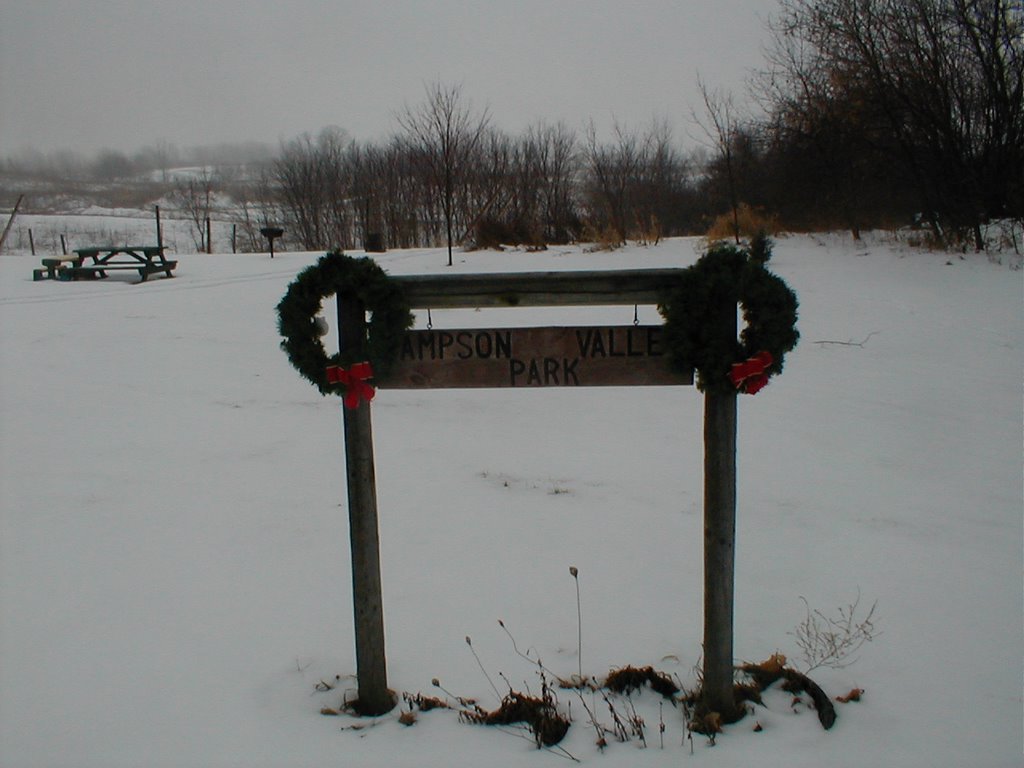
Christmas at Sampson Valley Vineyard


Finally got out to the vineyard this weekend. The first time since November. After having a couple of cold snaps (-2F was the coldest), we have been basking in the mid 30's for the last couple of days.

The Park Vineyard:

Things looking good so far. Things seemed to harden off well, and the deer haven't disturbed things as far as I can tell.

Since I will need to replace some of the foch that didn't make it, I cut about a dozen grape cuttings to attempt to root them. This is my first attempt at rooting, "Sticks" so it should be interesting. I have Lon Rombough's "the Grape Grower" to guide me.

Other wise everything is looking healthy there.


The Pit Vineyard:


The pit vineyard is still snuggly tucked under the tarps. I noticed that the tarps looked a little flatter than I expected. I thought the vines would be holding the tarps up more, but I don't think any harm was done. The warm weather the last few days is making a heavy wet blanket I'm sure. James was right, the north end did have about 10 feet of the top tarp layer pulled up, but I think the lower tarp was still in place.

I probably won't get back to the vineyard until sometime in January or February.

Friday, December 16, 2005

8 glorious inches of snow

Over the past few days we had about 8 inches of snow at the vineyard. Adding to the fluffy 4 already on the ground, the total is a healthy 12 inches.

All of this is very good for protecting the vines. We have not had any warm snaps lately this is great for maintaining the cold hardiness of the vines.

James mentioned that a few feet of the tarp may have come up on the north end of the pit vineyard. No need to worry with the snow cover. Temperatures should stay pretty steady in teens and 20's over the next week. So all is good.

Tuesday, December 06, 2005

It's getting cold!

We have had several nights lately where the temperatures have been in 0F range. We got to -1 F at my house here in Madison.

Just talked to my brother James, and it was down to -2F at the vineyard. Hope the experimental vinifera are snug and warm under their blanket ... well warmer anyways.

Saturday, November 12, 2005

Vinifera Covered

I covered the vinifera on Saturday Nov 12, with Kellan's help.

I used about 20 bails of dry hay that James and Charmaine has left over.
Along with about 13 rolls worth of insulation that were put directly
over the vines.

I pruned all 5 rows of vines up to and including 4 rows in from the
South. I spur pruned in hopes that I would have a crop next year. We
Will see what happens.

I found one bunch of grapes on the Cabernet Franc. Kellan and I tasted
them ... we both thought they tasted quite good.

I talked to James, and it sounds like the first real frost (hit about 27
F) happened around the 1 or 2 November. Mom said all the leaves were
gone by that Thursday.

I used 2 tarps 30x50 ft and 2 tarps 40x60 ft to cover the vines. I
staked the tarps every 3 feet. I used both regular stakes and the tall
green metal hollow core rods. I have the green side of the tarp facing up.

This should be the last vineyard update of the year other than notes on
temperatures through out the winter.

Sunday, October 23, 2005

Still no Frost

still no significant frost at the vineyard as of Sunday 10/23/2005. As
of writing this, I don't there has been a hard frost yet ... though I am
not sure, since I am down in Madison.

We had a frost yesterday am, and this morning ... the first frosts I
have recorded here.

Vines had some yellow in them, even a couple of red leaves. The
experimental vineyard, still looking bad due to the deer damage. Some
color there too. I think the deer may be still nibbling on whats left.

Pulled the irrigation hose (and the dock) on Saturday. Loosened up the
trellis wires too, although they already seemed quite loose.

Wednesday, October 12, 2005

No frost yet

I stopped by the vineyard last weekend, and we still
haven't had a frost. As of today, still no frost.

Some of the Park vineyard vines had a bit of yellow on the
leaves, but not really changing to fast. Noticed that
many of the wild vines have already changed yellow.

The pit vineyard, is still recovering from the deer damage
last month. Many of the newly sprouted leaves are light
green to yellow, but probably started out that way.
Noticed a hint of red in some of the older leaves. Not
sure if they will change or not.

Currently no frost predicted for the next 7 days.

Saturday, September 24, 2005

Those Darn Deer!

Hopefully mowed the Park vineyard for the last time this
year ... but who knows.... its been a warm wet September
in Sampson. I gave the two rows that will have the
LaCrescent vines about 5 lbs of muriate of potash. The
round up did a pretty good job. I also could tell that
the spot spraying among the older vines also did good.

The vines did have a few more areas succumbing to pm, but
overall things looked pretty good. Some of the Lacrosse
had some pretty big sprouts coming from near the base....
I probably will cut most of those off this winter anyway.

Things did not look as good in the pit vineyard. Last
time I was up the deer had fed pretty heavily on the
vines, but that was nothing compared to what I found on
Saturday. They had eaten about 80% of the vines....
anything above the ground was eaten .... even some of the
big canes were heavily gnawed on.

Not sure why they have become more active as of late, but
I suspect that the deterioration of the black plastic,
allowed the deer to become braver and enter the vine area.
I think the black plastic scared them when it was intact.

Not sure exactly when the deer ate the vines, but James
said he noticed it Tuesday of that week. The leafless
vines were sprouting new leaves already ... which is
probably a bad thing, since that energy should be getting
stored for the winter not going into new growth.


Since I didn't know when the frosts will hit, I removed
the two root stock shoots while I could still distinguish
them .... wow these were big ... almost 2 inch diameter.
Didn't know if I should leave it on since it was one of
the few things that the deer didn't eat, but I didn't
think I would be able to tell which ones were rootstock
with no leaves.

Sunday, September 04, 2005

My First Harvest from Sampson Valley Vineyard

Well the growing year for the vineyard is winding down ...
starting to prepare the vineyard for the wisconsin winter.

But first things first! Got my first harvest off my vines
.... well I did get a few clusters last year for my
neice's and nephew's port. But this year I actual got
about 11.5 lbs! enoug for 2 or 3 bottles of wine. Mom
James and Treva helped pick.

Later Mom and I picked another 6 lbs of wild grapes from
the rock pile in the middle of the bear field. These
while not real tasty, were edible. Some of the other wild
grapes on the farm were down right horrible. Maybe the
constant sun that these get made the acids tolerable.

The vineyard got about 2-3 inches in the weeks since I had
been there last. It had been about a week since the last
rain.

Park Vineyard
-------------
The vines had put on significant growth since then. Many
new shoots from their bases. The grass also really took
off, so I gave it what hopefully will be its last mowing.

After receiving soil and leaf tests that pointed to a
significant Potassium shortage in the vineyard. I spread
about 7 lbs of murate of potash on the top four rows and
the next two longer rows. I put about 2-3 tablespoons
around each vine ... maybe some too close to the base ...
I hope I didn't burn the trunks!

I then put about 5 lbs of potash derived from sulfates
around the vines in the two bottom rows ... this is
suppose to be more organic...

I also sprayed RoundUp for the two rows of LaCrescent I
will be planting next year. I also spot sprayed RoundUp
in the first 4-5 rows. Most being used on the seedless
concord rows and the LaCrosse rows.

The lacrosse vines still looked pretty bad, but some newer
signs of life were showing up as sprouts near the bases.

Pit Vineyard
------------

I thought deer danger was over, but the dear had a field
day in the pit vineyard. I would estimate that they ate
about a 1/3 of the foliage. I think they will be okay,
but it was a pretty significant hit. It looks like they
didn't even touch the two root stock sprouts. I guess
they prefer vinifera. Over all things looked okay. Not
as good as if they had not gotten in there.

Since a freeze may hit the vineyard before I return, I
pulled the Water pump. I also pulled the irrigation
hoses. I need to bring antifreeze for the pump the next
time I come up.

I plan on getting the tarps this week, and will cover up
the vinifers at the end of October or maybe at the
beginning of November. I may even trim them down a bit
...

I still need to cut off the root stock growths from row 2
vine 12, and row 5 vine 5.

Monday, August 29, 2005

Picked grapes at Mitchel Vineyard Aug 26, 2005

Friday I picked about 60 lbs of Foch grapes at Mitchel Vineyard near Oregon, WI.

The grapes were 4th year foch grafted on 3309 root stock. This was the first harvest from
these vines.

The amount of grapes hanging were impressive. It took very little time for me to pick 60
lbs of grapes (about 45 minutes) The 60 lbs of grapes filled two 7 gal fermenter buckets.
I had half of them crushed.

From what I have been reading lately, it sounds like things are ripening quite fast this
year. Even near Minneapolis, the grapes are getting close to pick. I don't have a
refractometer yet, but I may pick this weekend in my vineyard. I hope to have about 20
lbs of foch.

I may pick some wild ripera also. and try to make a wine from it.

My vineyard in Sampson had over 2 inches of rain Friday night (8/26/2005), so the brix may
have dropped on them ... we will see how things look.

Sunday, August 14, 2005

Mid August update


Another productive weekend in the vineyard. I didn't
report the last time (weekend of July 30-31) so I'll give
that first.


July 30-31
I was surprised to see how many weeds had grown since the
previous visit (about 2 weeks earlier) The rows Loyal and
the kids weeded were pretty weed free, but since we hadn't
had too much rain up there at the time I was surprised how
many weeds were in the other rows. I ended up taking the
weed whipper to them I then sprayed one of the upper rows
with RoundUp to see how that works.

Starting to get dry up there. I didn't see any noticeable
affect on the vines, although some of the foliage is
looking a little spotty. By that I mean maybe a little
mildew ... not sure. I also see that many of the vines in
the lower middle part of the vineyard was looking like it
had some sort of nutrient deficiency. All of the
Lacrosse look bad ... not sure if it was because they got
hit so hard by the Rose Chafers, or if it is disease or a
nutrient problem.

No sign of Japanese beetles this year ... yea! Some of
the berries on some of the grapes did not look good
though. I thought it may be black rot, also in some
places the seeds of the grapes were pushing through the
vines.

The experimental pit vineyard looks awesome despite no
moisture for a while, the ground felt moist beneath the
plastic. The plastic had a few large rips in it. I think
they are due to the plastic getting brittle from sun
exposures. The vines all look very healthy and quite
large.


August 13-14

It was getting VERY dry up at the vineyard .... finally
got about 2 inches of rain a few days before I got up
there. Some of the cottonwoods are changing colors
already it was so dry. Grass didn't grow much, so that
gave me more time to spend on other things.

I put up 2 more trellis wires. I also hauled a few more
loads of stone to the seedless concord. I took leaf and
soil samples from 30 vines 10 old foch, 10 new foch, and
10 lacrosse. The soil samples were from the area of each
vine

I also got 3 samples of leaves that looked diseased for
Mike to look at under the microscope.

The grapes are already going through verasion ... most are
nearly complete. I think I will have about 40 clusters
... unless the birds get them first. I tried one berry,
and was surprised how sweet it was, and it was not as
acidic as I would have thought.

The Lacrosse still look terrible I'm afraid I may lose
some this winter. The foch look good, not great, but
good. The saint pepin look very good. If I can get them
to pollinate next year, I expect to have a small crop next
year.

The Landot noir are recovering nicely after most died back
to the roots after the winter.

As far as the pit vineyard ... what can I say ...
spectacular. Nearly all of the cab franc and merlot are
huge many with over 300 leaves each. some climbing over 5
ft already. One trunk looked to be an inch in diameter
already! Only the cab sauvignon is behind, but not too
bad. Some are nearly as large as the others. 5 did not
make it, but one did sprout eventually that I thought did
not make it. I now believe that I should have put up the
hoop house the first year. Definitely will next spring.
I have not irrigated these vine since mid July. Probably
could have through July. I will next year if they are
under a hoop house.

Sunday, July 17, 2005

No sign of Japanese Beetles and Status

As of Sunday July 17 I have not seen any sign of the Japanese beetles. But I did find one
on my grapes in my backyard in Madison, so unfortunately they may still show up.

On Saturday July 16, I finished putting up trellis wire for the 4 long rows of Foch. Two
upper wires were needed to be complete. I also put in an upper wire for the saint pepin
which is doing VERY well. That leaves a top wire for Lacrosse row 2, lower wire for saint
pepin. Upper and lower for Landot Noir and upper and lower for seedless concord.

Three of my nephews ...Kellen, Brent, and Trevor , and my Brother-in-law Loyal got a lot
of weeding done this weekend. They completely weeded the three lower rows of foch.
Unfortunately, the rows at the top that had been weeded very well a few weeks ago were
once again filled with weeds.

I've decided to abandon my hopes to keep the park vineyard organic .... if I lived next to
it, maybe, but since I live so far away, it just doesn't seem possible.

I will probably use RoundUp next year ... and maybe a little this year. I think I will
start preparing a location with RoundUp for next year's Lacrescent vines.


The test vinifera vines were irrigated on Saturday for about 5 hours. No disease or
insect problems are apparent so far.


Varietal assessments so far ...

Foch
----
Doing very well. Seemed to fair the best from the Rose Chafer invasion. I decided to
let several clusters hang on the healthier vines. Lost a few over the winter in the lower
south east corner. But over all, the best of the lot ... I will be pruning some down to
the ground next year to develop better trunks.

Landot noir
-----------
Probably had the most severe winter kill, but comes back strong. I don't have a
trellis wire up yet, but will by the end of the summer. Lost a few of these also, but not
as many as I feared. Remains to be seen if they will be able to handle the NE Wisconsin
winters. Also left alone by the Rose Chafers.


Saint Pepin
-----------
Seems to be the most vigorous of my vines. Wintered very well, and has good strong
growth. The Rose Chafers did a number on a few of them, but they quickly recovered. I
will probably have a decent crop next year.

Lacrosse
--------
These poor guys are really suffering. The Rose chafers hit them very hard, and they
have been slow to recover. After being quite vigorous the first few years, they are
taking this summer very hard. I may prune these guys down to their bases, and retrain
them up for next year.

Seedless Concord
-----------------
Like the lacrosse, these were also attacked quite hard. The surprisingly, a few that
I had given up for dead have recovered. It remains to be seen if they will do well next year.


Test Plot Vines.
----------------

Cabernet Sauvignon
------------------
Doing well considering that they were not planted until Memorial Day. 6 vines did
not make it at all. The remaining 9 are slow, but coming along.

Cabernet Franc Row 2, Merlot, Cabernet Franc row 4, and Chardonnay
------------------------------------------------------------------
All vines are growing and very vigorous (1 cab franc in row 4 finally budded out, and
is much behind the others). Look completely disease and insect free. I irrigated them
again on Saturday ... for about 5 hours. No vine losses from these at all. I may water
once more, and then that will be it for the year. The experiment is going very well so far.

Friday, June 17, 2005

Rose Chafers Attack


This weekend I came to the vineyard to find new problems. The biggest of which was the
attack of the Rose Chafers at the Park vineyard. There were none the previous Sunday
(June 12), but by Saturday June 18, they had completely consumed and apparently killed
about 4 of the seedless concord near the east and of the row. They were also severly
eating several of the LaCrosse and a few of the St Pepin. I saw some on other plants, but
it was the firs four rows on the east end that were attacked most visiously.

I directly sprayed several of the infested plants with Sevin. but I didn't go overboard
spraying since some of the gapes still had flowers, and I didn't want to harm the honey bees.

Fred Dombrowski had cut hay in the adjoining field on Wednesday, and I don't know if this
contributed to the infestation.

The pit vineyard was reletively unscathed.

I had my nephew Brent as my helper this week.

Several weeds had reappeared since last week, but it wasn't terrible. It was Brents duty
to pull weeds, although he spent a lot of time fighting off horse flies, Rose Chafers and
Bumble bees.

Brent also helped me get some of the trellis wire up. ... I was able to get about five or
6 lengths of wire up. I still have about 10 lengths to go. But I'm getting there.

I was able to get the irrigation for the pit vineyard going. I water it for about 3.5
hours on Sunday ... each of the 75 vines had a 1 gal/hour dripper next to it.

The pit vines looked fairly healthy. The Cabernet Sauvignon, that had only been planted 3
weeks earlier, were just begining to leaf out. Most of the other vines had a healthy
about of leaves coming from them.

I think I saw only 3 or 4 vines from the Cab Franc, Merlot, and Chardonnay that did not
have leaves.